
AQL vs 100% Inspection: Which Quality Control Method Is Right for You?
Nov 30,2025
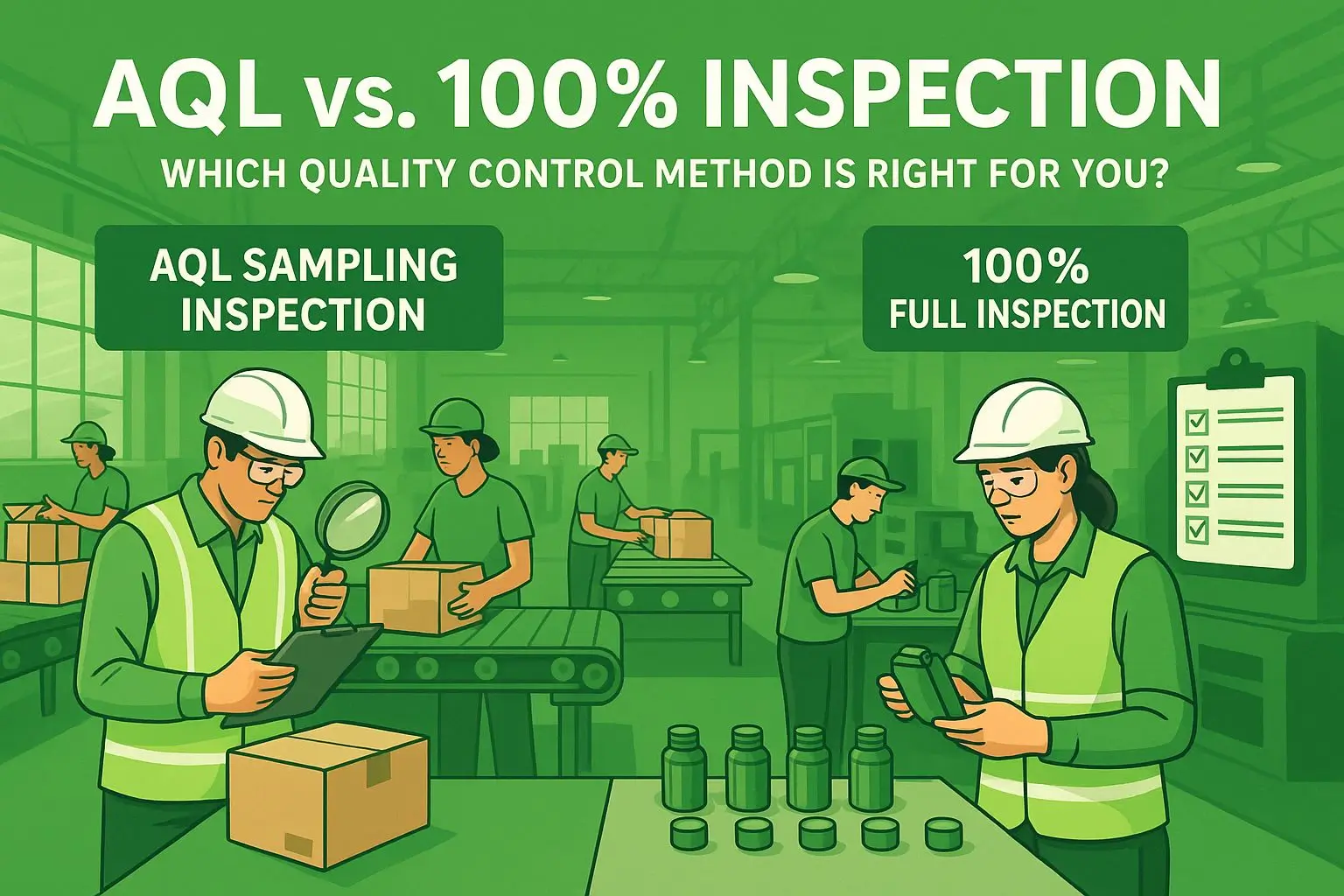
Quality control is a critical aspect of manufacturing and product sourcing. As an importer or e-commerce seller, you need to ensure your goods meet expectations without having to personally inspect each item. Two common quality control methods are AQL sampling inspection and 100% inspection.
Each method has its own advantages, costs, and applicable scenarios. In this guide, we will explain these two methods in simple terms, compare them, and help you determine which method is more suitable for your product and risk level, as well as how QCC inspection can support you in practice.
What Is AQL Sampling Inspection?
Acceptable Quality Level (AQL) sampling is a statistical quality control method that inspects only a representative portion of a production batch, rather than every single product.
Inspectors randomly select a sample according to a standard sampling table and count the number of defects found. The overall batch is then judged based on the results.
Defects are typically categorized into three types: critical defects, major defects, and minor defects. For many consumer products, common limits might include: critical defects 0%, major defects 2.5%, and minor defects 4.0%.
Critical defects almost always result in automatic rejection, while a small number of minor surface imperfections may still be considered acceptable.
The inspection results are straightforward:
If the number of defects found in the sample is within the allowable limits, the batch is considered acceptable and can be shipped.
If the number of defects exceeds the limits, the batch is considered unacceptable and may require rework, sorting, or rejection.
The main advantage of AQL sampling is its efficiency. By inspecting only a portion of the batch, AQL significantly reduces the time and cost of quality inspection while still providing statistically significant overall product quality information. This is especially important in high-volume production or when destructive testing is involved.
However, AQL also has limitations. Sampling cannot guarantee the detection of all defective items. If the number of defects is small or unevenly distributed, they may be completely missed.
Despite these limitations, AQL remains one of the most widely used routine pre-shipment inspection methods because it achieves a practical balance between risk control and cost-effectiveness.
What Is 100% Full Inspection?
100% inspection, or full inspection, refers to inspecting every single product in a batch according to established standards. Unlike sampling-based decisions, 100% inspection requires checking each product individually and rejecting or reworking defective items.
Its main advantage lies in its extremely high quality assurance. If 100% inspection is conducted properly, almost all defects can be detected and eliminated before shipment.
This is especially important for products that are safety-critical, subject to strict regulations, or of extremely high value, as even a single defective product can lead to serious consequences, legal disputes, or damage to brand reputation.
Full inspection is commonly used for products such as medical devices, automotive or aerospace components, critical industrial parts, or high-end luxury goods, because customers expect these products to have near-perfect quality.
Its disadvantages lie in cost and time. Inspecting every single product in a large order is extremely labor-intensive, significantly slowing down the supply chain, and the difference in labor costs is often equally significant.
Human factors are also crucial. When inspectors repeatedly check thousands of units, fatigue and inattention are real risks. In fact, even a “100%” inspection performed manually may miss a small number of defects. Automation and testing equipment can help reduce this problem, but they also increase investment costs.
In short, 100% inspection provides the greatest assurance, but requires a significant investment of time and money. It’s best used only when defects are absolutely unacceptable.
Comparing AQL Sampling and 100% Inspection
When comparing AQL sampling with 100% inspection, factors such as coverage, defect detection rate, speed, cost, and risk should be considered.
Regarding coverage, AQL inspects only a portion of the batch and uses statistical data to assess quality, while 100% inspection inspects every single unit. Therefore, AQL offers controlled risk, while 100% inspection provides near-complete coverage.
Regarding defect detection rate, AQL can reliably detect patterns and systematic problems, but rare defects that never appear in the sample may be missed. A properly performed 100% inspection aims to find all defects, but human error can reduce this ideal outcome.
In terms of speed and efficiency, AQL has a clear advantage for large-volume orders. Inspecting smaller samples reduces inspection time and helps maintain shipment schedules. 100% inspection is inherently slower and more prone to delays if poorly planned.
In terms of cost, less inspection time means AQL is generally more economical, especially for high-volume, low-margin products. Full inspection typically requires several times the manpower or equipment of sampling inspection, thus incurring higher costs.
For very small order volumes or simple product structures, the cost difference may be smaller, but in most cases, sampling inspection is the more economical choice.
Finally, risk and product type determine which method is more suitable. AQL is suitable for many common consumer goods because these products can tolerate a small number of minor defects. 100% inspection, on the other hand, is more suitable for high-risk or high-value products, where even a single defect is unacceptable.
In summary, AQL prioritizes efficiency and offers moderate risk, while 100% inspection prioritizes certainty but is more expensive.
When Should You Use Each Method?
Typically, when your product is a general consumer good with high sales volume and low profit margins, you would choose AQL sampling. In this case, a small number of minor defects are permissible, and your main goal is to control quality without affecting delivery speed or increasing costs excessively. AQL is also a good option if you have a strong, long-term relationship with your supplier and historical data shows consistent product quality.
When quality is closely related to safety or legal risks, or when the product is expensive and your brand image requires impeccable quality, you might consider 100% inspection.
Furthermore, 100% inspection is also an effective tool when working with new or less reliable suppliers, such as after an initial order or following a serious quality issue. In this case, 100% inspection helps you verify that the supplier can meet your standards before resorting to sampling.
Sometimes, regulations, contracts, or customer requirements explicitly mandate 100% inspection. In such cases, there is little room for compromise, and 100% inspection becomes mandatory.
You can also use these two methods alternately. For example, you can first conduct 100% inspection on the initial batches of orders from a new factory.
Once the non-conformance rate decreases and trust is established, you can then switch to AQL inspection. Similarly, if AQL inspection fails, you can conduct 100% sorting inspection on the same batch of products to distinguish between qualified and defective products.
Best Practices to Make Either Method Work
Choosing the method is only part of the story. To get real value from your quality control, you also need a clear and disciplined process.
First, define your quality expectations in detail. This includes clear specifications, tolerance limits, defect definitions and classification into critical, major and minor categories. Agree on AQL levels if you use sampling, and make sure your supplier and your inspection partner share the same understanding.
Second, plan the timing of inspections. Many importers only focus on final random inspections, but for larger or more complex orders it often makes sense to add checks earlier in production. During-production inspections can catch problems early enough for the factory to correct them before everything is finished.
Third, control human error. Train inspectors well, give them realistic workloads and avoid pushing them to rush. For 100% inspections or repetitive checks, consider rotating assignments or using basic automation tools where possible.
Finally, have a clear plan for what happens when inspections fail. Decide in advance how to handle rework, re-inspection, sorting, or batch rejection, and specify who pays for extra inspections when quality problems come from the factory side. Written quality agreements with suppliers help avoid arguments when issues occur.
How QCC Inspection Can Help?
Partnering with experienced third-party organizations makes implementing the right combination of AQL sampling and 100% inspection much easier.
QCC Inspection supports importers and e-commerce sellers across a wide range of product categories. Our inspectors are professionally trained to correctly apply international sampling standards and perform rigorous 100% inspection when necessary.
We can help you select the appropriate AQL level, develop a practical checklist, and design an inspection program tailored to your risk level, budget, and shipping schedule.
For AQL-based inspections, QCC provides clear and easy-to-read reports summarizing defect findings, including photographs, and clearly showing pass/fail results according to agreed-upon acceptance criteria.
For 100% inspection, we can assemble a dedicated team, establish efficient inspection processes, and ensure all products are inspected and categorized according to your requirements.
One of our strengths is flexibility. Many clients choose a hybrid approach, using AQL inspection for routine shipments and 100% inspection for high-risk orders, new suppliers, or critical components.
QCC can work with you to design these hybrid programs and adapt them to changes in supplier performance and business needs.
QCC (Quality Control Circle) inspection services act like your eyes and ears in the factory, allowing you to control product quality without being physically present. You can focus on sales and growth, while we focus on ensuring your products meet your commitments to your customers.
Conclusion
AQL sampling and 100% inspection are both powerful tools in quality management, but they solve different problems.
If you need an efficient, scalable method for large volumes and can accept a controlled level of risk, AQL sampling is usually the right choice. It helps you keep costs down and shipments on time while still protecting your brand from major quality failures.
If you require maximum assurance, deal with safety-critical or high-value goods, or are working with an unproven supplier, 100% inspection gives you the extra confidence that every single unit has been checked.
In many cases, the best strategy is a flexible combination of the two: use AQL as your standard approach, tighten AQL levels or add extra checks for higher-risk products, and reserve full inspections for situations where the stakes are highest.
When you partner with QCC Inspection, you don’t have to make these decisions alone. Our team can help you analyze your products and suppliers, design a practical QC plan, and carry it out reliably in the factory. With the right inspection strategy, you protect your customers, your reputation, and ultimately your long-term business success.
--- END ---
Products
Get A Free Quote
Related Blogs
 December 31,2025
QCC SAMPLE REPORT
For sample reports or custom checklists, please contact us – we're here to assist you.