Industrial ProductsConstruction Products | Metal & Piping Products | Production Equipment | Mechanical Parts & Systems | Transportation Equipment | Molds & Dies | Other Products
Home > Food QA vs. QC: A Manufacturer’s Guide to Quality Excellence
Blog
Trust our expert team of highly experienced inspectors to thoroughly inspect your products before shipment, minimizing risks and ensuring compliance with international standards.
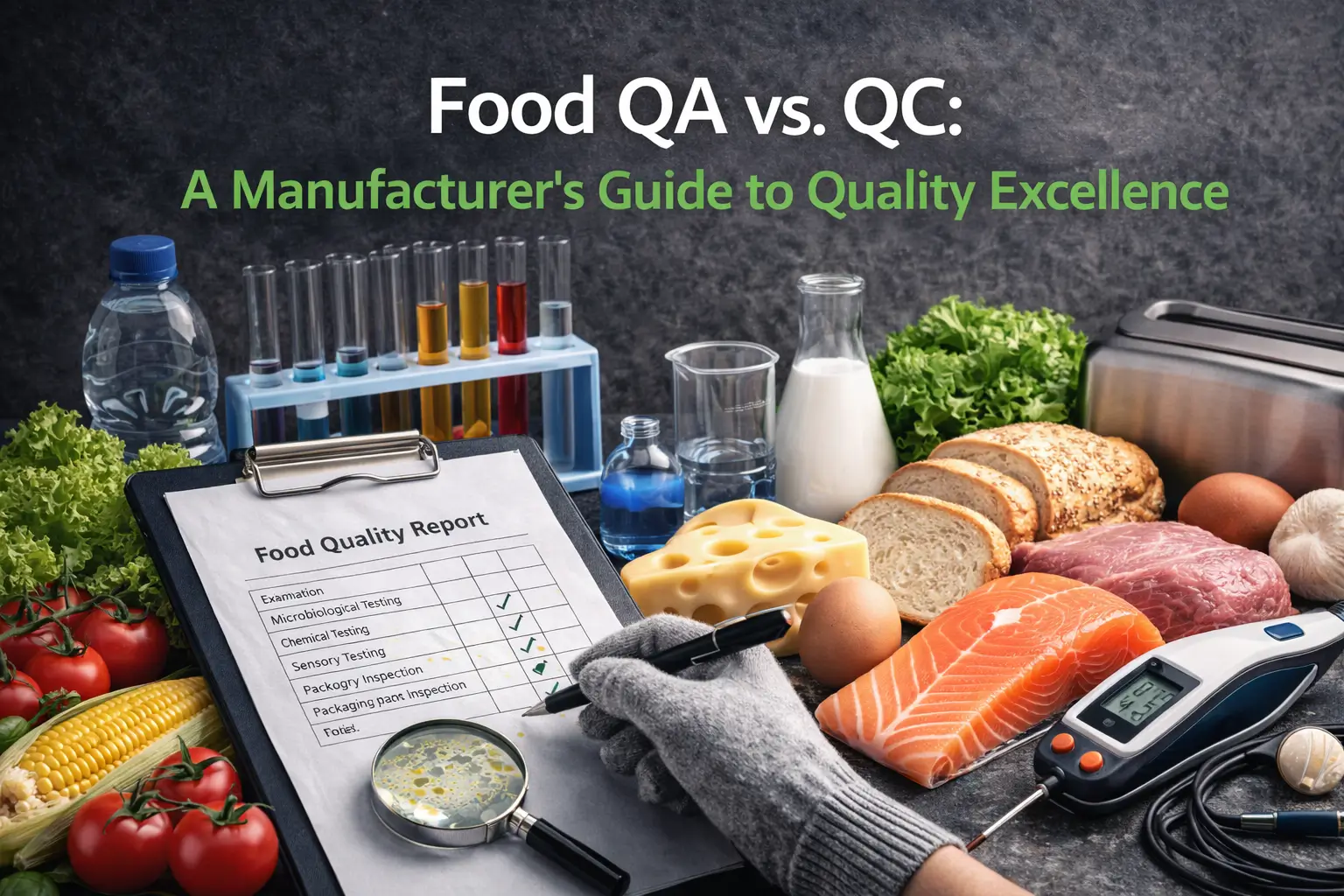
Food QA vs. QC: A Manufacturer’s Guide to Quality Excellence
Dec 31,2025
Food quality management is no longer limited to meeting basic safety requirements. With increasingly complex supply chains and rising consumer expectations, effective food quality control and assurance systems have become core priorities for business operations.
This guide will detail how food quality control (QC) and quality assurance (QA) work together, the key components of modern food inspection programs, and how manufacturers can improve production efficiency through structured quality management.
The High Risks of Food Quality Management
Food quality control (QC) refers to the operational activities carried out before finished products are released to the market to ensure they meet established safety and quality standards. It is the last line of defense between production and distribution, helping to protect consumers from physical, chemical, and biological risks.
Modern food manufacturing faces multiple pressures. Raw materials often come from multiple countries, production lines operate at increasingly faster speeds, and regulations are constantly evolving.
Bridging the gap between raw material production and retail preparation requires a structured inspection system, reliable data, and consistent implementation across all factories.
Professional inspection services, such as QCC Inspection, can help manufacturers maintain consistency between production standards and market expectations without disrupting operations.
QA vs. QC: Understanding Their Roles in Food Production
Although often mentioned together, Quality Assurance and Quality Control serve different functions within food manufacturing. A strong system depends on both.
Quality Assurance: Process-Oriented and Preventive
Quality Assurance focuses on building reliable processes that prevent issues before they occur. Rather than inspecting individual products, QA looks at how food is produced.
Common QA activities include:
Developing and maintaining HACCP plans
Creating standard operating procedures (SOPs)
Conducting internal and external audits
Training personnel on hygiene and handling practices
QA establishes the framework that guides production, helping facilities operate in line with FDA regulations, GFSI schemes, ISO 22000, and GMP requirements.
Quality Control: Product-Oriented and Operational
Quality Control operates on the production floor and in laboratories. It involves direct evaluation of products at specific stages of manufacturing.
QC activities typically include:
In-line and final product inspections
Laboratory testing and sample analysis
Visual and sensory checks
Verification against product specifications
QC ensures that each batch meets defined standards before release.
A production line can follow strong procedures and still experience deviations. Likewise, inspection alone cannot compensate for weak processes. Manufacturers aiming for regulatory alignment and consistent output rely on QA and QC as interconnected systems rather than isolated functions.
Core Components of Food Quality Control
Effective food QC programs address multiple risk categories simultaneously. Each component targets a different type of potential failure.
Physical Inspection and Foreign Body Detection
Physical hazards such as metal fragments, plastic pieces, or glass remain a major concern in food processing.
Quality control teams monitor:
Foreign object detection systems
Product weight and volume accuracy
Packaging integrity and sealing
These checks help ensure products meet safety and labeling standards while reducing consumer complaints.
Testing schedules vary depending on product type, processing environment, and regulatory expectations. Consistent microbiological control reduces the likelihood of contamination reaching the consumer.
Sensory Evaluation and Product Consistency
Beyond safety, food quality also includes sensory characteristics.
Trained inspectors evaluate products using the five senses:
Sensory testing helps manufacturers maintain batch consistency and detect deviations that laboratory tests may not reveal.
Advanced Methodologies: Six Sigma and Automation in Food QC
Applying Six Sigma to Food Manufacturing
Six Sigma methodology is being increasingly applied to reduce variation and waste in food production processes. The DMAIC cycle (Define, Measure, Analyze, Improve, Control) provides a structured approach to identifying inefficiencies and quality gaps.
Inspection providers such as QCC Inspection integrate these tools into modern quality programs, allowing manufacturers to track trends, identify risks earlier, and maintain documentation across supply chains.
Packaging and Labeling Compliance in Quality Control
Seal Integrity and Transport Protection
Packaging serves as the final barrier against contamination.
Accurate labeling supports regulatory compliance and consumer trust.
Why Manufacturers Use Third-Party Food Inspection Services?
Objective Evaluation
Internal teams may face pressure from production targets. Third-party inspectors provide independent assessments that help identify issues without internal bias.
Specialized Expertise
External inspection providers offer access to trained inspectors, calibrated equipment, and up-to-date regulatory knowledge. This expertise is especially valuable for complex or high-risk products.
Scalability Across Locations
For manufacturers operating multiple facilities or sourcing from different regions, third-party inspection services support consistent quality oversight without expanding internal headcount.
QCC Inspection, for example, works across diverse production environments to help manufacturers manage quality at scale while maintaining operational flexibility.
Building a Sustainable Food Quality Culture
Food quality is not achieved through a single inspection or audit. It develops through consistent systems, trained personnel, and data-driven decision-making.
Manufacturers that invest in structured QA and QC programs often see benefits such as:
Fewer production disruptions
Reduced recall exposure
Improved supplier accountability
Greater confidence during regulatory inspections
Quality becomes part of daily operations rather than a reactive response to issues.
Conclusion
Food quality control and assurance work in tandem to protect consumer rights, ensure compliance, and maintain brand reputation. From physical inspection and microbiological testing to packaging verification and digital monitoring, each step contributes to building a more robust quality system.
Manufacturers who view quality as an ongoing commitment rather than a final checkpoint are better positioned to adapt to regulatory changes and market demands. Partnering with experienced testing organizations helps reinforce this philosophy throughout the production line and supply chain.
Contact QCC Inspection to discuss how to tailor a food quality audit program to your production objectives.

 December 31,2025