
Lighting Inspection: Types of Tests and Global Standards
Nov 11,2025
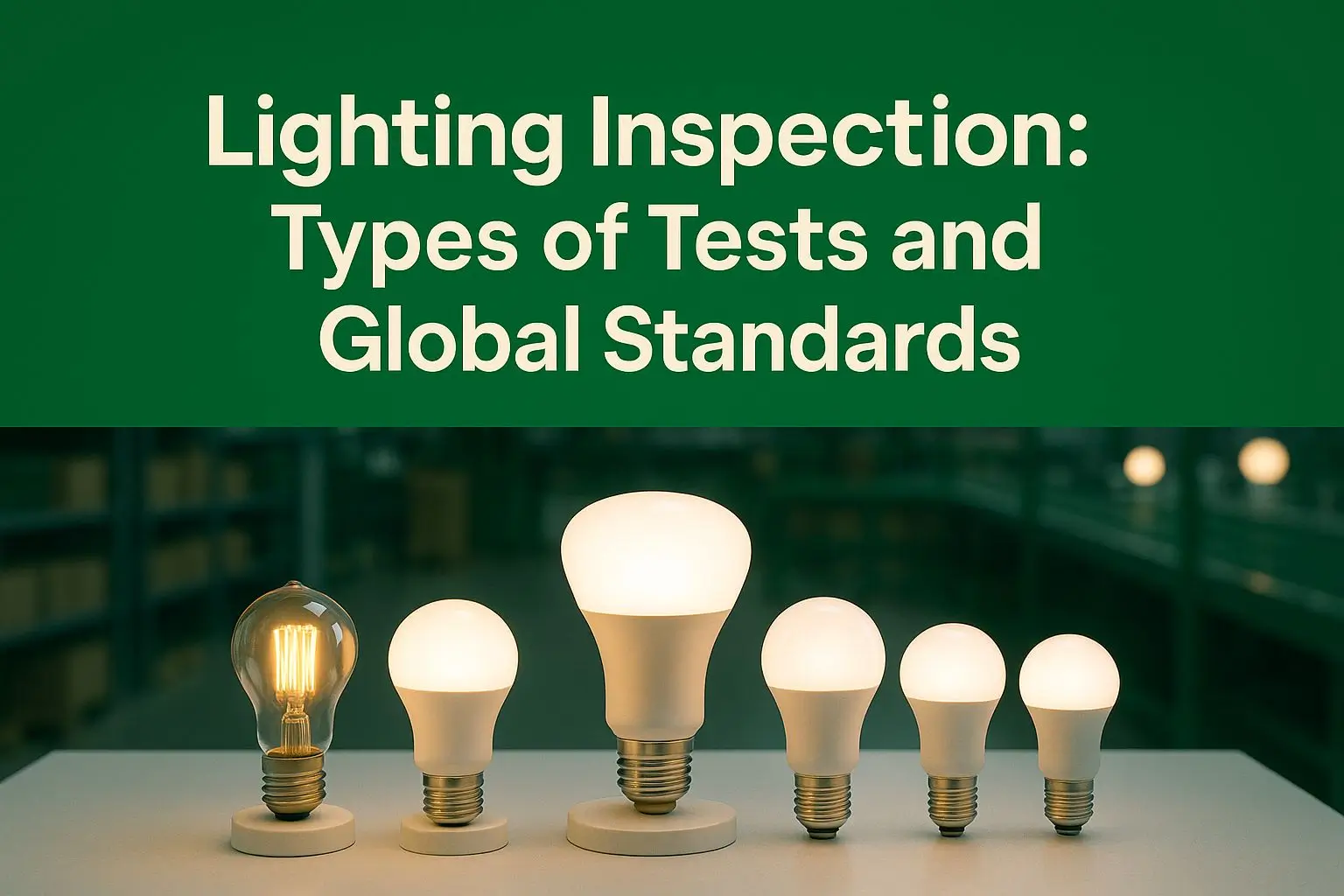
Lighting products are ubiquitous, ranging from household LED bulbs and office lighting fixtures to streetlights and automotive lights. For importers, ensuring the high quality and compliance of these products is paramount.
Even a single batch of defective products can lead to safety hazards, costly recalls, or even customs seizures. To mitigate these risks, lighting products must undergo rigorous quality, safety, and regulatory compliance testing before being released to the market.
In this blog post, we’ll briefly outline which lighting products require inspection, the main types of tests, key global standards, best practices, and how QCC Inspection can support your lighting product projects.
Scope of Lighting Products & Why Inspection Is Critical?
Almost all lighting devices should undergo quality control:
- Light bulbs (LED, CFL, incandescent, halogen)
- Luminaires and fixtures (ceiling lights, panel lights, downlights)
- Outdoor lighting (streetlights, floodlights, garden lights)
- Specialty and industrial lighting (automotive lamps, high-bay lights, explosion-proof lights)
Although they vary in design and application, they all need thorough inspection to ensure safe and reliable operation.
Why is inspection critical?
- Safety:Defects in wiring, insulation, or grounding can cause electric shock or fire.
- Energy efficiency:Verifying wattage, lumen output, and efficacy ensures products deliver the promised performance and don’t waste energy.
- Market access:Non-compliant products can be rejected at customs or recalled from the market.
- Customer satisfaction:Flicker, early failure, or poor light quality quickly damage your brand reputation.
By inspecting lighting products before shipment, importers can catch issues early and avoid accidents, regulatory problems, and unhappy customers.
Key Types of Tests in Lighting Inspection
Lighting inspections combine visual, functional, electrical, photometric, and durability checks. A streamlined program typically includes:
Visual Inspection
Inspectors look for visible defects such as cracks, deformation, poor surface finish, loose parts, or poor assembly. Labels, ratings, and safety marks must be correct, complete, and permanent.
Functionality Test
The product is powered on to verify basic operation and features (on/off, dimming, CCT adjustment). Inspectors check for flickering, unstable brightness, abnormal noise, or start-up problems to make sure the light behaves as specified.
Electrical Safety Tests
Key checks include:
- Hi-pot (dielectric strength) testto ensure insulation between live parts and accessible surfaces.
- Earth continuity testto verify grounding for metal-bodied products.
- Leakage current and power consumptionmeasurements to confirm safety and rated wattage.
These tests help prevent electric shock and fire hazards.
Photometric & Performance Tests
Performance tests verify:
- Luminous flux (lumens) and luminous efficacy (lm/W)
- Correlated color temperature (CCT)
- Color Rendering Index (CRI)
Using tools like integrating spheres and photometers, inspectors confirm that brightness, color, and efficiency match product claims and any labeling requirements.
Thermal Testing
Lighting, especially high-power LEDs, generates heat. Thermal tests measure temperature at key points (heat sink, driver, housing) under normal operation. The goal is to ensure temperatures stay within rated limits so components don’t degrade prematurely or create fire risk.
Mechanical and Durability Tests
To ensure the product survives shipping and handling, inspectors may perform:
- Simple drop testson the product or packaging
- Vibration testsfor products used in vehicles or harsh environments
- Torque testsfor screws and connectors
These checks help confirm robustness in real-world use.
Ingress Protection (IP) Testing
For outdoor or damp-location lights, IP ratings (such as IP65 or IP67) must be verified. Tests simulate dust exposure and water jets or immersion to confirm the product’s claimed protection level and avoid water damage or short circuits.
EMC/EMI Tests
Electronic lighting can emit or be affected by electromagnetic interference. EMC tests ensure the product doesn’t disturb other devices (like radios or Wi-Fi) and can operate normally in typical electromagnetic environments, in line with regulatory requirements such as FCC or equivalent.
Endurance and Lifespan Checks
Full lifetime testing is usually done in labs over thousands of hours, but on-site inspections can include burn-in tests or accelerated on/off cycles to reveal early failures and major lumen depreciation issues.
Material and Component Verification
Inspectors check key components against the approved bill of materials: LED chips, drivers, capacitors, cables, plastics, and other parts. They verify that critical components are from the specified brands and that materials meet safety and environmental requirements (e.g., flame retardancy, RoHS).
Global Standards and Regulatory Requirements
Lighting regulations vary by market, but they all focus on safety, EMC, and energy efficiency. Importers must understand which standards and marks apply to their target markets.
United States
- UL certification(e.g. UL 1598 for luminaires) for electrical safety.
- FCC Part 15for electromagnetic emissions.
- ENERGY STAR and other energy-efficiency programs for performance and efficiency.
- LED performance is often assessed with LM-79(photometric) and LM-80 (lumen maintenance) data.
European Union
- CE marking to show compliance with EU directives.
- Key standards include EN 60598(luminaires safety), the Low Voltage Directive, EMC Directive, and ErP Directive (eco-design and efficiency).
- RoHS limits hazardous substances; REACH governs chemical safety.
- Correct EU labeling and energy labels are required before sale.
China
- CCC (China Compulsory Certification)for many lighting products, with testing to GB safety and performance standards.
- Optional CQCmarks can demonstrate higher quality or additional compliance.
Other Regions
- Japan:PSE mark and JIS standards.
- Australia/New Zealand:RCM mark, plus MEPS for energy efficiency.
- Middle East:SASO and GCC G Mark for safety and efficiency.
- India:BIS standards for lighting and BEE star ratings for energy efficiency.
Aligning with the correct standards and marks is essential to avoid customs issues, fines, or recalls, and it strongly supports product quality and safety.
Best Practices for Implementing Lighting Inspections
A good lighting inspection program depends not only on what you test, but also when and how you test. Importers can follow these core practices:
Turn standards into a clear checklist
Translate all relevant requirements into a practical, product-specific inspection checklist. This keeps inspectors focused on what matters and ensures consistent execution across batches and factories.
Inspect at multiple stages
Don’t rely solely on a final inspection.
Combine:
- An Initial Production Checkat the beginning
- A During Production Inspectionaround mid-production
- A Final Random Inspectionbefore shipment
Early-stage inspections catch systemic issues before large quantities are produced.
Combine on-site checks with lab testing
On-site inspections cover visual, basic electrical, and functional tests. For detailed photometry, full safety certification, IP tests, or EMC reports, use accredited labs and integrate those results into your approval process.
Keep up with changing standards
LED technology and regulations evolve quickly. Review and update your specifications and inspection checklist regularly, and communicate updates to suppliers and inspectors.
Audit suppliers and their quality systems
Factory audits reveal whether a supplier has robust processes for incoming material control, in-process checks, and equipment calibration. Fixing root causes at the factory level reduces problems downstream.
Use professional third-party inspections
If you lack in-house expertise, independent inspectors give you impartial, technically sound evaluations. They help enforce your standards, improve communication with factories, and give you reliable data for shipment decisions.
How QCC Inspection Can Support Your Lighting Product Program?
Lighting quality control can be very complex, especially with cross-border shipping, but you don’t have to handle it alone.
QCC Inspection, established in 2010, is an independent third-party inspection company with extensive experience in the electrical and electronic products sector, including LEDs, luminaires, and accessories.
We support importers in the following ways:
On-site Lighting Inspection
QCC inspectors will travel to your supplier’s premises to conduct initial production inspections, in-process inspections, and pre-shipment inspections. They will conduct critical lighting tests on-site, including functional testing, basic safety checks, process assessments, and verification of labels and IP protection ratings (where applicable).
Customized Checklists and Reports
We will work with you to develop customized checklists that meet your standards and target markets. Sampling follows international AQL principles, and you will receive detailed reports with photographs to help you quickly decide whether to accept, rework, or reject the goods.
Laboratory Testing Coordination
For certification or advanced testing, QCC coordinates with accredited laboratories to assist you in managing sample submissions, test selection, and result interpretation.
Supplier Audits and Continuous Improvement
Before you place an order, QCC can audit the lighting factory, assessing its capabilities, quality system, and equipment. If issues are found, we provide practical recommendations to support your supplier’s development and mitigate long-term risks.
Dedicated Support for Importers
QCC has served hundreds of international clients and is your local quality partner in Asia. We provide structured reports, typically within 24 hours of inspection, keeping you informed of your order’s status in real time. Our mission is to protect your business by ensuring your lighting products are safe, compliant, and reliable.
Conclusion
In the highly competitive and regulated lighting market, quality control is paramount. From standard light bulbs to advanced LED systems, every lighting product must undergo inspection and testing to ensure its safety, performance, and compliance.
By understanding your product range, the critical tests required, and the applicable standards for your target market, you can design a comprehensive inspection program. Combining multi-stage inspection, a clear checklist, supplier audits, and expert support can significantly reduce the risk of failures, delays, and customer complaints.
Whether you manage your inspection efforts yourself or partner with a professional organization like QCC Inspection, the goal remains the same: to provide safe, efficient, and reliable lighting products, thus building long-term success for your brand.
FAQs
Q1. What’s the difference between LM-79 and LM-80 in LED lighting testing?
LM-79 describes how to test the luminous performance of a complete LED luminaire under specific conditions. LM-80 describes how to test the luminous flux maintenance of an LED light source over a long period.
In short: LM-79 tells you about the initial performance of a product, while LM-80 helps predict how its brightness will decrease over its lifespan. Both standards are crucial for evaluating the quality of LEDs.
Q2. Can a lighting product be certified for multiple countries at once?
No single certification can cover all markets, but mechanisms like the CB Scheme allow test reports from one member country to serve as the basis for certification in other member countries. You still need individual certification marks, but the same core test data can often be reused, thus simplifying the multi-country certification process.
Q3. How long does a lighting inspection typically take?
Standard on-site lighting inspections typically take 1-2 days at the factory, depending on batch size and complexity. If additional laboratory testing is required, this can add several days to several weeks. Therefore, it is essential to plan inspections and laboratory tests well in advance and allow for some buffer time before the shipping date.
--- END ---
Products
Get A Free Quote
Related Blogs

 December 31,2025
QCC SAMPLE REPORT
For sample reports or custom checklists, please contact us – we're here to assist you.